## Background of the Protests - Author: Lin Al‑Saadi - Role: BBC News Arabic – Damascus - Published: – - Reading time: 5 minutes
In recent days, demonstrations in multiple Syrian cities that originally called for the prosecution of individuals responsible for violations committed during the rule of former President Bashar al‑Assad have turned into security‑related tensions in several areas. Authorities now face a delicate test: delivering justice without reigniting the divisions left by years of war.
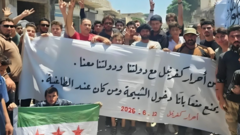
### Demands for Accountability Protesters are demanding that those they label “remnants of the former regime” be held to account for past abuses. They also call for the removal of former regime figures from positions of influence and for barring them from certain neighborhoods. Some demonstrators allege that former regime elements have been reconciled and reinstated in governmental and security posts.
## Security Clashes and Casualties The protests have occasionally turned violent, with assaults on individuals accused of ties to the old regime and the breaking of several shop windows. In the city of Tadmor (rural Homs), clashes resulted in eight injuries from stone‑throwing, according to the Ministry of Interior of the Syrian transitional government.
## The Mazza 86 Flashpoint and Fears of Revenge Heightened anxiety emerged over the potential sectarian nature of the unrest after some protesters shouted slogans targeting the Alawite sect, to which the Assad family belongs. Images circulated urging those linked to the former regime to leave certain towns.
- Mazza 86, a predominantly Alawite district in Damascus, remains under a cautious calm after protesters attempted to enter the area on Tuesday night. Security forces sealed the district’s entrances for several hours. - Residents reported limited attacks, broken shop windows, and one person wounded by stabbing. Police urged locals to stay indoors and established a security cordon to prevent further escalation. - A female resident, who asked to remain anonymous, said she witnessed young men carrying sticks and chanting offensive remarks toward the Alawite community. She added, “I support holding perpetrators accountable, but we must distinguish between ordinary citizens who just want to live and those truly responsible for bloodshed. Revenge in this manner will only breed more hatred and violence.”
## Barzeh Demonstrations and Calls for Containment A similar scene unfolded on the capital’s outskirts when demonstrators from the Barzeh district marched toward the Ash al‑Wurur area, also Alawite‑majority.
Osama Ali Rajab, Speaker of the Barzeh Municipal Council, told BBC Arabic that the slow progress on the transitional‑justice file, combined with harsh economic conditions, has fueled public frustration. He emphasized that residents understand the need to prosecute those responsible for violations within a legal framework that prevents arbitrary arrests or vendettas.
Rajab noted that local elders asked demonstrators to avoid approaching the neighboring district, stressing that “reasoned awareness is paramount, and the nation’s highest interest is peace; people do not want confrontation.”
## Human‑Rights Organizations Warn Against Collective Punishment Syrian human‑rights groups reacted to the protests, cautioning that demands for justice could slip into unlawful retaliation. They urged the authorities to safeguard public order while ensuring that accountability follows proper judicial procedures.
Journalist and rights activist Yamen Hussein described the protests as a manifestation of mounting frustration among a segment of Syrians who view the delayed promises of the transition as a betrayal. Hussein observed a rise in incendiary, sectarian rhetoric on social media targeting Alawites and residents of areas formerly under regime control, warning that such discourse threatens to widen societal rifts.
He added that the intertwining political and economic crises, together with the government’s failure to address them, have amplified public discontent, while some power brokers appear to be channeling popular anger toward scapegoats for their own shortcomings.
## Government Stance on Transitional Justice The transitional Syrian government reiterated its commitment to a justice and accountability pathway.
- Justice Minister Mazhar al‑Wais posted on X (formerly Twitter) that the state continues to prosecute those involved in violations during the former regime’s rule and will not allow impunity. - Interior Ministry spokesperson Nour al‑Din al‑Baba emphasized at a press conference that prosecuting perpetrators is a right of the victims, and that the judiciary and security institutions bear the responsibility for delivering that right. - Both ministries have intensified the publication of recent investigative findings and security operations that have led to the arrest of individuals linked to the old regime. The Justice Ministry disclosed testimonies from detainees accused of committing a crime against a patient in the Tishreen Military Hospital during the conflict, which resulted in the patient’s death. - Additional security actions included the arrest of the former head of the security and military committee in the southern region under Assad’s rule, the detention of a notorious prison guard, and the dismantling of a cell the Interior Ministry described as a spy network acting as an arm of the former regime in Syrian territory.
The Transitional Justice Commission issued a statement on Monday affirming victims’ and families’ rights to truth, justice, and accountability. It stressed that transitional justice rests on individual responsibility, rejecting collective punishment or extrajudicial retribution. The commission warned that mass retaliation conflicts with justice principles and human‑rights standards, potentially creating new grievances that threaten civilian peace.
## Ongoing Debate Over Justice Mechanisms These protests have revived debate over how Syria can achieve justice, which institutions are empowered to implement it, and how to navigate a complex security and social landscape populated by numerous actors accused of wartime violations.
Key questions focus on the limits of individual accountability versus collective affiliation, and how to differentiate genuine perpetrators from those merely associated with a particular group. The discussion occurs amid growing concerns that escalating tensions could jeopardize civilian stability.
In sum, while victims continue to demand accountability for past abuses, warnings about the danger of turning popular anger into collective punishment place Syrian authorities before a complicated test: delivering transitional justice without reproducing the sectarian fissures that the war created.



![[Pending Translation] كأس العالم 2026: الولايات المتحدة تضمن حضورها في الدور الثاني بعد فوزها على أستراليا 2-صفر](https://s.france24.com/media/display/e98fad16-66c8-11f1-96db-005056bfb2b6/w:1024/p:16x9/2026-06-13T013936Z-709115587-UP1EM6D04LZCZ-RTRMADP-3-SOCCER-WORLDCUP-USA-PRY.jpg)