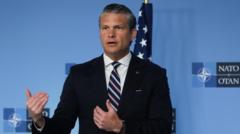
## U.S. Defense Secretary’s Criticism of NATO Allies Pete Hegseth, the U.S. Secretary of Defense, delivered a stark rebuke to several NATO partners during a meeting of defense ministers in Brussels. He accused unnamed allies of “free‑riding” and of limiting assistance to U.S. forces in the ongoing conflict with Iran. Hegseth said the upcoming review would see “some countries fail, and others pass with flying colours.”
## Six‑Month Review of U.S. Forces in Europe Hegseth announced a six‑month assessment, dubbed “NATO 3.0,” intended to ensure the alliance moves quickly toward a Europe‑led security posture. A U.S. official told the BBC that no decision has been made yet. The review follows a U.S. decision to scale back its commitments to the NATO Force Model (NFM), a high‑readiness force component. Details of the reduction have not been released, but they are expected to affect air and naval capabilities.
## NATO Defense‑Spending Targets The United States is urging NATO members to increase defense spending to meet a collective target of 5 % of national GDP by 2035—comprising 3.5 % on core defense and 1.5 % on related infrastructure. NATO Secretary‑General Mark Rutte noted that defense outlays rose by almost 20 % last year, amounting to €90 billion (£78 billion; $103 billion), and that European nations are already “backfilling” resources the U.S. is cutting back.
## Changes to the NATO Force Model The NATO Force Model is a set of forces that the alliance’s Supreme Allied Commander Europe (SACEUR) can count on at short notice. A senior NATO official acknowledged that “not everything” the U.S. withdraws can be fully replaced, but Rutte said work is already underway and the changes take effect immediately.
## Reactions from NATO Leaders Hegseth warned that NATO dues would become “contingent on other countries meeting their defense‑spending targets; where other allies do not spend with urgency, our dues contributions will go down.” He did not name specific nations. Rutte, speaking ahead of the Ankara summit (7‑8 July), urged members to present clear, concrete plans for achieving the 5 % target, noting that many are already on track.
## Developments in the United Kingdom New UK Defense Secretary Dan Jarvis attended the summit without a finalized defense‑investment plan but pledged to work “around the clock” to deliver one. He emphasized the need to equip the armed forces for a “very dangerous” world. Jarvis succeeded John Healey, who resigned after warning that the proposed funding fell “well short” of what the UK requires.
## Recent U.S. Troop Movements In May, the United States announced a withdrawal of 5,000 troops from Germany after a dispute between President Donald Trump and German Chancellor Friedrich Merz over the Iran war. The same month, Poland was told 4,000 troops would be pulled out, only for Trump to reverse the decision and promise 5,000 troops instead. Poland currently hosts up to 10,000 U.S. troops on a rotational basis, and Defence Minister Władysław Kosiniak‑Kamysz said the United States is open to a permanent base, pending a detailed agreement. Earlier, Trump threatened to halt trade with Spain after Madrid refused to allow the use of its air bases for attacks on Iran; the U.S. operates Naval Station Rota and Morón Air Base there.



![[Pending Translation] كأس العالم 2026: الولايات المتحدة تضمن حضورها في الدور الثاني بعد فوزها على أستراليا 2-صفر](https://s.france24.com/media/display/e98fad16-66c8-11f1-96db-005056bfb2b6/w:1024/p:16x9/2026-06-13T013936Z-709115587-UP1EM6D04LZCZ-RTRMADP-3-SOCCER-WORLDCUP-USA-PRY.jpg)