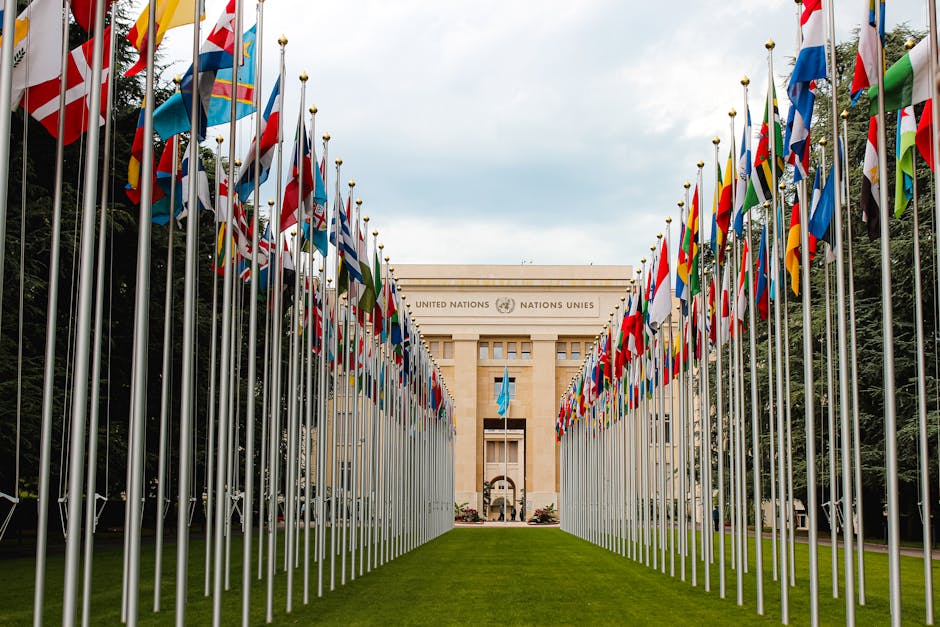
## Delay of Vice President JD Vance’s Planned Trip to Switzerland The White House announced early Friday that Vice President JD Vance has postponed his scheduled Friday visit to Switzerland, where he was to meet Iranian officials for the next phase of the U.S.–Iran agreement aimed at ending the Middle‑East conflict.
A White House spokesperson said, “As the Vice President noted in his press briefing, the final details of the upcoming technical talks have not been set, and the U.S. delegation was ready to depart at the earliest opportunity.”
The spokesperson added that the logistical aspects of the negotiations proved neither easy nor predictable, so Vance will not travel that night. The administration hopes to start the technical discussions “as soon as possible.”
## Iranian Skepticism About a Formal Signing Ceremony Iran’s foreign ministry questioned the necessity of a formal signing ceremony in Geneva, stating it is unnecessary after the two heads of state signed the agreement on Wednesday.
Earlier on Thursday, the semi‑official Tasnim news agency reported that Iranian negotiators want visible U.S. implementation of the interim deal before any new peace‑talk rounds begin, and that no Iranian delegation has been confirmed for Geneva.
Swiss officials had indicated that U.S. and Iranian representatives would meet in Switzerland on Friday for preliminary talks, according to a Reuters‑cited statement.
## Supreme Leader Khamenei’s Approval of the Memorandum In a handwritten letter to the Iranian people, published by state media on Thursday, Supreme Leader Ayatollah Ali Khamenei said he had approved the memorandum of understanding signed by the Iranian and U.S. presidents, even though he initially held a contrary view.
Khamenei explained that, based on the Iranian president’s commitment—acting as head of the Supreme National Security Council—to protect the Iranian people and the resistance front, he granted his consent.
He also noted that Iranian negotiator Mohammad‑Bagher Qalibaf described the leader’s message as a “road map,” promising to issue orders that will “focus our eyes.” Qalibav, a senior negotiator, pledged to respect the “red lines” and to deliver a “justified response” to any enemy overstep.
## Technical Provisions of the Agreement * Free passage through the Strait of Hormuz for 60 days – as stipulated in Article 5 of the memorandum, to be financed by the Islamic Republic. * Commercial vessels wishing to transit must apply to the Gulf Strait Authority; additional measures such as mine‑clearance will be carried out under the same article. * On the day after the agreement’s signing, three super‑tankers flying the Saudi flag and carrying 6 million barrels of oil sailed through the Strait, marking the first large‑scale flow since the war‑induced disruptions. * A French LNG carrier, the Mraikh, transporting over 76,000 tons of liquefied natural gas from Qatar’s Ras Laffan to Pakistan’s Port Qasim, also passed the Strait on Thursday, according to MarineTraffic. * The United States announced that 12.5 million barrels of oil have already moved through the Hormuz corridor.
## U.S. Military Posturing U.S. Defense Secretary Pete Hegseth warned that Washington would resume military action and re‑impose the naval blockade if Iran fails to honor its commitments under the agreement. He made the statement to reporters after meeting NATO defense ministers in Brussels.
Deputy Defense Secretary Steven Fineberg told lawmakers that the Pentagon needs $80 billion to fund the war effort against Iran, in addition to other unrelated expenses.
## President Trump’s Reaction on Social Media President Donald Trump responded to criticism that he was “not tough enough” on Iran with a post on Truth Social, saying, “Those fools who think I wasn’t tough enough with Iran while the stock market hits record highs and oil prices crash are either jealous, bad, or stupid. Let’s make America great again!”
## Legislative and International Commentary * Several U.S. lawmakers have condemned the memorandum, arguing it does not sufficiently curb Iran’s nuclear ambitions and leaves Tehran free to leverage the Strait of Hormuz. * The International Atomic Energy Agency (IAEA) Director‑General Rafael Grossi said the agency is ready to take “concrete steps” on Iran’s nuclear program but cautioned against speculative technical concerns at this stage. * Iranian Parliament Speaker Mohammad Bagher Qalibaf called the agreement a “failure” of the United States, while Pakistan’s Prime Minister Shehbaz Sharif praised the deal for immediately reopening the Strait of Hormuz and lifting the U.S. maritime sanctions. * Qatar’s foreign ministry described the memorandum as a “solid foundation” for the next phase of bilateral talks.
## Oil‑Market Impact Following the announcement of the agreement on Sunday, Brent crude fell 2.1 % to $77.87 per barrel by 05:25 GMT on Thursday, marking a more than 2 % decline and the lowest price level since the war began.
## Outlook The memorandum triggers a 60‑day negotiation window aimed at reaching a final settlement to the U.S.–Iran conflict that began on 28 February. The agreement also calls for Iran to reduce the enrichment level of its uranium stockpile under UN supervision, a point described by a U.S. official as a “huge gain.”
If a comprehensive deal is reached before the 60‑day period ends, all sanctions would be lifted and Iran could resume full oil exports. The United States has also signaled willingness to contribute to a $300 billion reconstruction fund, though officials say Washington is not legally bound to do so.
--- The article reflects information available as of June 18 2026.



![[Pending Translation] كأس العالم 2026: الولايات المتحدة تضمن حضورها في الدور الثاني بعد فوزها على أستراليا 2-صفر](https://s.france24.com/media/display/e98fad16-66c8-11f1-96db-005056bfb2b6/w:1024/p:16x9/2026-06-13T013936Z-709115587-UP1EM6D04LZCZ-RTRMADP-3-SOCCER-WORLDCUP-USA-PRY.jpg)